
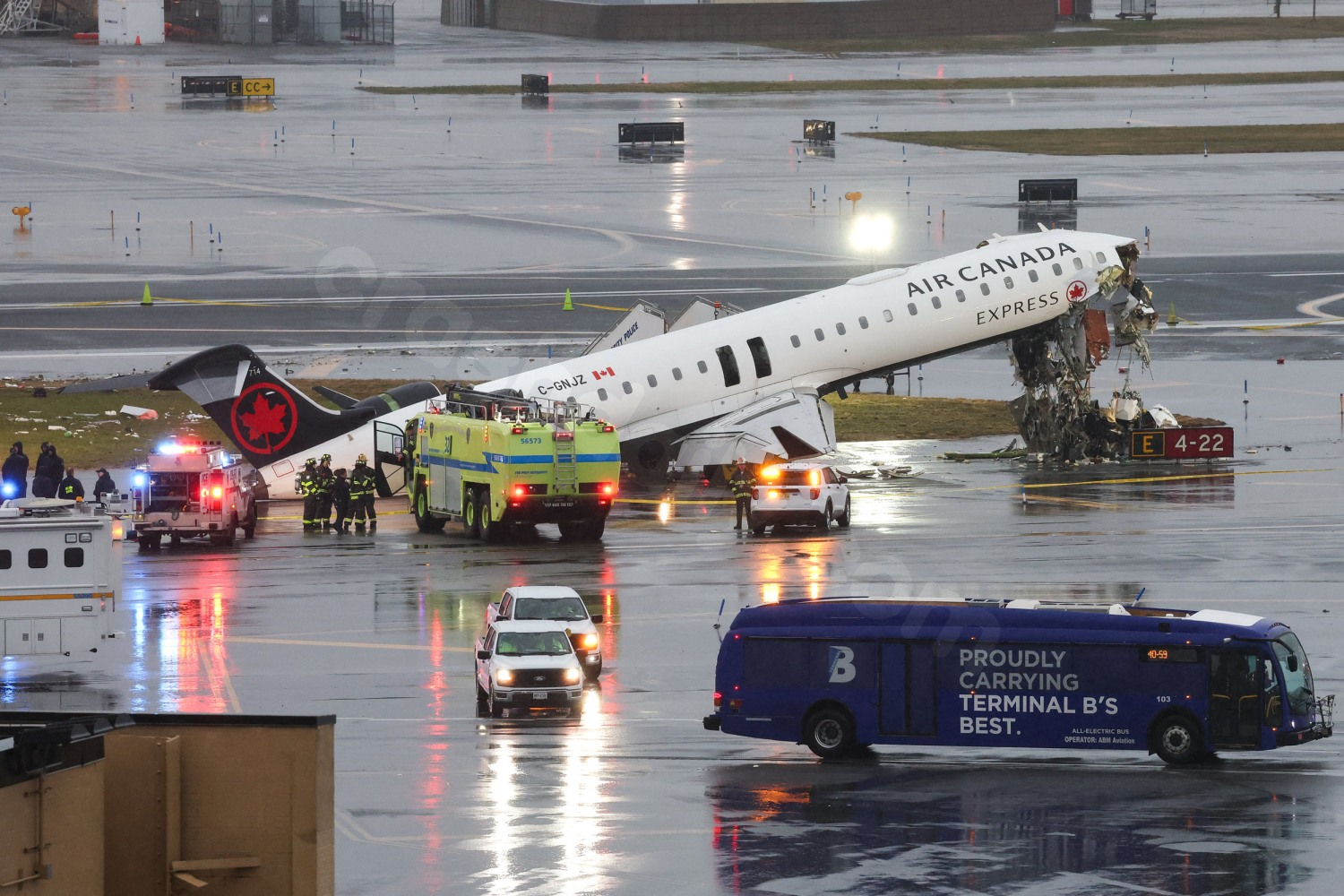
What Caused the Deadly LaGuardia Plane-Truck Collision? Investigators Looking at Multiple Failures
Investigators continue to look into potential human and technological issues that may have caused the deadly runway collision between an Air Canada jet and a firetruck at New York’s LaGuardia Airport on March 22. “There are multiple, multiple layers of defense built in to prevent an accident, so when something goes wrong, that means many, many things went wrong,” National Transportation Safety Board Chair Jennifer Homendy said March 24 at a press conference. The NTSB, Federal Aviation Administration and other agencies are among those investigating what happened before the vehicle drove across the runway in the path of the plane as it touched down. An official determination of the likely cause of the crash is expected to take some time. “A preliminary report is expected within 30 days from the date of the accident,” the NTSB states on its website. “The preliminary report will contain factual information gathered during the initial phase of the investigation. A probable cause of the crash and any contributing factors will come in the final report, which is expected in 12 to 24 months.” Fire Truck Was Cleared to Cross the Runway Officials with the NTSB released information from the cockpit voice recorder showing that the truck was given clearance to cross the runway 20 seconds before the collision. Nine seconds before the crash, though, the tower told the truck to stop. Six seconds before the collision, the flight’s first officer transferred control of the plane to the captain. Four seconds before the accident, the tower again told the truck to stop. Investigators say they plan to do a full review of the cockpit voice recorder and what pilots Antoine Forest and Mackenzie Gunther — who died in the collision — may have been saying before the crash. There also appears to be confusion about who in the control tower may have given permission for the truck to drive on the runway. Homendy confirmed there were two people there. “We have conflicting information. We have some information saying it was the controller in charge. We have some information saying it was the local controller,” she said. She also said it’s not uncommon for two controllers to be on during a midnight shift, while also acknowledging the NTSB has shown concerns in the past about employee fatigue. “I do not know. I have no indication that was a factor here, but it is a shift that we have been focused on in past investigations,” she said. Failure of Ground Radar Detection Homendy said ground radar detection that is supposed to inform air traffic controllers of a potential crash also also may have failed. LaGuardia has Airport Surface Detection Equipment, Model X, or ASDE-X, which allows air traffic controllers to track the movement of vehicles. Before the March 22 collision, "the ASDE-X system did not alert," Homendy said. She also said the fire truck was not equipped with a transponder that relayed its movements. “That could have led, in this case, to a lack of warning to the controller,” NBC aviation analyst Jeff Guzzetti said on TODAY March 25. Previous Report of Communication Issues at LaGuardia A pilot also contacted NASA’s anonymous Aviation Safety Reporting System months before this crash to say the communication at LaGuardia was in disarray. “LGA is starting to feel like DCA did before the accident there,” the pilot wrote, referring to the 2025 crash when an American Airlines regional jet and Black Hawk Army helicopter collided, killing 67 people. “Please do something,” the pilot added. Passenger Experiences in the LaGuardia Collision More than 40 people were sent to area hospitals after the collision. Passengers praised the two pilots who were killed for their efforts to save lives. “I think everybody on that plane feels very grateful that they’re all alive, and they all pretty much give it to the pilots,” passenger Jack Cabot told NBC News. “They really just did the best they could.” “I fully believe that these two pilots, who unfortunately lost their lives, did everything in their power to stop the plane and slow it down at the very last minute,” another passenger named Joseph, who asked to be identified by his first name due to restrictions from his job on speaking to the media, said. “They deserve all the credit for being heroes that day.” The accident appeared to take place swiftly and without much warning. Christopher Pal was a passenger onboard and has a black eye as a result of the collision. “My daughter was asking me, like, ‘When did you know there was trouble?’” he recalled in an interview, part of which aired March 25 on TODAY. “And I told her when my face hit the seat in front of me. So, it happened very suddenly.”
Leave a Comment

Popular News


Recent News

Weather

 76%
76% 0 MPH
0 MPH
-
 21° July 21, 2026
 -
 27° July 21, 2026